John's Blog
Plein Air Painting in the Flint Hills
I just returned from three days of plein air painting in the Flint Hills of Kansas. I remember, as a young boy, passing through the area several times a year with my folks on the way to visit my grandparents in Pittsburg, Kansas.
The Flint Hills were first given the name in 1806 when explorer, Zebulon Pike, referred to the soil as being “flinty”. Early European settlers found plowing pretty much impossible because of a thick layer of underlying bedrock made up of flinty limestone. As a result, the region is sparsely developed and represents the last expanse of intact tallgrass prairie in the nation…and the best opportunity for the sustained preservation of this unique habitat once covering the great plains.
Millions of American Bison once grazed the area. Today one sees mainly cattle, but bison are also being reintroduced to the area. (Click images to enlarge)

Flint Hill painters: Back row L>R: Kim Cassbeer, Cally Krallman, Judy Mackey, Debra Groesser Front row L>R: Marc Hanson, John Pototschnik, Joseph Loganbill, Susan Lynn, Dick Sneary, Michael Albrechtsen, (Not shown: Phil Starke)
Painting in the Flint Hills is not easy. It’s not the kind of place in which you can just show up and discover incredible motifs over every rise and around every corner. Trees, structures, even vistas can be difficult to find. Horizontal is the word that comes to mind when in the Flint Hills…layer upon layer of rolling horizontal lines. I think all of us artists sought verticals and diagonals to add balance to our compositions.
Although this is the third time I’ve painted the region, getting to the essence is not an easy task.
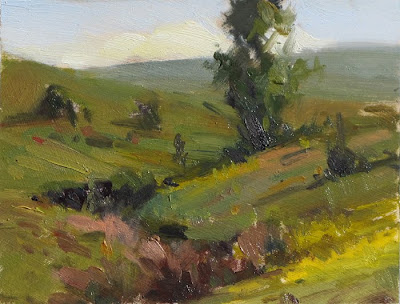
Shown here are my attempts.
Kim Casebeer organized this paint out and she wisely knew we would all like to experience a Flint Hills sunset. So, late one afternoon our Flying W Ranch hosts had us all pile into a 1956 Ford grain truck and they drove us to a high point. All of us painted this amazing vista as the light rapidly changed. The challenge was sticking with the original motivation and not “chasing the light”, as artists often say. I was guilty of this amateur mistake as I continually warmed up the landscape in order to keep up with the descending sun.

Mike Albrechtsen and I found this view. It was also one that Marc Hanson painted. Appealing textures, color variations, and rise and fall of the land were sufficient motivations for attempting this painting.

I enjoy painting farm scenes that include silos. While Marc and Michael painted a large pond just off to the right, I decided on this view.
Black and white ladies with large udders enjoyed dancing in the nearby pond but they gradually worked their way toward me. Ever so curious, nudging ever closer, they pressed in until I almost couldn’t move. They checked out everything. I felt my whole set up was in danger of going down. My loud warning to, “Go away”, fell on large, deaf ears. However, somehow I knew they must have approved of my work as they flipped their tails and nodded their heads. I hung in there and they eventually grew bored with my efforts to capture their home turf.
This is the view from the bunkhouse area of the Flying W Ranch. Painted early one morning, I was attracted by the long shadows and the winding road inviting one to see what’s around the corner.
On our last evening together, many of us painted on Coyne Creek Road. I found this location extremely appealing and sought to create an unusual composition. I was painting while standing in deep shadow so was totally shocked when I saw the painting in natural light. It was way too light and did not capture the observed mood at all. Back in the studio, I darkened the values in an attempt to get closer to reality.
One of the difficulties of painting during midday is the flatness of the light. This painting gave me fits. I had to take significant artistic liberties just to get to this point.
Next week I hope to show the favorite paintings produced by each of the plein air participants.
Kicking the Can Down the Road
Is OPA Judging Rigged?
If you want to be juried into an art show, or win an award in a show, it’s important that you have “connections”. Knowing the judge or jurors doesn’t hurt, maybe even being involved in the host organization will further your changes of winning something, anything…Right?
Accusations of award winners being preselected or friends being shown favoritism are occasionally leveled against art organizations by disappointed applicants. Oil Painters of America is not immune from such criticism. The question is, is there justification for such accusations?
Recently, within the last three weeks, I was bestowed the honor of seeing how an OPA Selection Committee works…from the inside out. I was one of five judges chosen to select the paintings that will be in the OPA Western Regional Exhibition this October at the Lee Youngman Galleries in Calistoga,
Now that all the selections have been made, I am able to tell you how it works.
First off, you need to know, I still do not know who the other four jurors were…and will probably never know. I asked out of curiosity, after the judging was completed, but received no response. Another thing, only two people knew the identity of the five jurors, the OPA President and the Jury Chairman.
We had four days to rate the 924 entries, grading them on a scale from one to seven. The entries were viewed using the internet and we had no way of knowing how other jurors voted. After all the grades for each painting were compiled we were given an additional three days to reevaluate the top 190 entries scoring them in the same way…one to seven. Those receiving the highest cumulative scores were selected for the show.
I did not enter the competition this year, but if I had, I was instructed to vote for my painting in order to avoid any possible computer processing issues. However, it was the average score of the other jurors that would have been substituted for my vote. So, even in that, the temptation to show favoritism toward one’s own work was eliminated.
Paintings were evaluated based on design and execution. The best works had one dominant value, a dominant color harmony, a clear center of interest, balance, accurate drawing, convincing value relationships, consistent and believable color temperature relationships, appropriate variety of hard and soft edges, and varied and interesting paint application.
Get all those elements right and you ended up with a seven…in the top 1-3 percent of entries.
I have judged many art shows and only once did I sense a little urging to vote a certain way…and that was for an Elementary School art competition.
Oh, you may be wondering if the artist’s signature on a painting has an influence. Well, to be very honest, I make it a matter of personal integrity to avoid looking at the signature. If the focal point of the painting is located in the area of the signature, there’s no need to be concerned about awards.
I’m sure if an advantage can be gained in any art competition, there will be those who will try to get that advantage. But, as for the Oil Painters of America Exhibitions, I was most impressed to see just how unbiased the jury process actually is. This should be an encouragement to many of you. Hey, it all comes down to the quality of the work, not to who you are or whom you know.
Below are website links to those featured in this article:
Jeff Legg
Paul Calle
I learned just this past week that » Read More
Cornish Pasties
ACA Demonstraton
Don Adair
One just never adjusts to the reality of death. One moment here, » Read More
George Washington Carver
Born in Missouri, educated in Kansas and Iowa, he was not only a chemist but also an accomplished artist, having won an honorable mention for one of his paintings at the 1893 Chicago World’s Fair.
His many discoveries led to international fame. He became a confidant and advisor to leaders and scientists from all over the world. Henry Ford, Thomas Edison, President Franklin Roosevelt, Calvin Coolidge, even Mahatma Gandhi sought his talents.
As incredible as all his achievements and fame are, that is not what I find most appealing about him. Although well trained in his chosen profession, it’s his humility of character and the way in which he approached his creative work that I find extremely attractive.
As most creative people will admit, they create best when alone. Dr. Carver was like that. He entered his laboratory alone and would lock the door behind him. He once said, “Only alone can I draw close enough to God to discover His secrets.” He believed God would show him what questions to ask and how to conduct each experiment. He reasoned that the One whom created the plants was also the same One who had all the answers as to their use.
In 1921, Carver accepted an invitation to address the United States Senate Ways and Means Committee concerning the potential uses of the peanut and other new crops to improve the economy of the south. Asked by the Chairman of the Committee how he learned all these things, Carver answered, “From an old book.” “What book?” asked the Senator. “The Bible”, replied Dr. Carver. “Does the Bible tell about peanuts?” inquired the Senator. “No Sir”, Carver replied, “But it tells about the God who made the peanut. I asked Him to show me what to do with the peanut, and He did.”
As a Christian and an artist, I am drawn to Dr. Carver’s love for God and his absolute trust in Him to guide his work. He once said, “My work, my life, must be in the spirit of a little child seeking only to know the truth and follow it. My purpose alone must be God’s purpose – to increase the welfare and happiness of His people…”
&;
Creativity, the ability to create, is a gift to us from God. It didn’t just light upon us through some impersonal cosmic happenstance. With the gift comes responsibility. George Washington Carver understood this and we, as artists, can learn from his attitude as it applies toward our life’s work. He was a man of unusual creativity and humility and possessed an attitude worthy of emulation.
My Speech to the Topics II Book Club
The following is a speech I presented in May 2003 to the Topics II Book Club – a group of teachers and educators associated with St. Mark’s School in Dallas. My purpose was to talk about art and artists in general, and painting in particular. From an artists point of view I also hoped to bring encouraging words to those wishing to develop their creativity.
It’s a privilege to be invited to speak to you this afternoon. As I look out over this audience I see highly educated, well-dressed, sophisticated people and I feel like I’m out of my element. Artists after all are perceived to be moody, unconventional, eccentric, weird, unpredictable, irresponsible, undependable, undisciplined, drugged, either a loner or a communer, illogical, disorganized, definitely a leftist, and probably poor, but not really concerned about it. If you see anyone like this, I advise you to turn the other way and run as fast as you can.
You know, these perceptions saved me a traffic ticket one evening. Those were the days when I had a studio in the Turtle Creek area. One night after a long, hard day at the “office”, I was in a hurry to get home and see my wife and just zipping along in my little car when I noticed those awful red lights in my rear view mirror. The police officer, I could see, already had his pad out before he got to my car. “Do you realize how fast you were going?”, he asked, as he began filling out that unwanted ticket. “No Sir”, I said, “I had my mind on other things and wasn’t aware of my speed. I’m hurrying home to see my wife.” Then, for some reason, he asked what I did for a living. “I’m an artist”, I said. At that he threw up his arms and exclaimed, “Oh, that explains it! My brother-in-law is an artist and you’re all eccentric.” At that, he put the pad back in his pocket and bid me a good day as I slowly continued on my way, grateful for being an artist.
These perceptions that others have of us artists have contributed to creating an atmosphere in which just about anything is called ART. So we wonder, what makes something art and what gualifies one to be called an artist?
I’ve compiled a list of the art movements occuring within just the last 100 years or so and I don’t even know what some of these are and I’m sure I have not listed all of them – but here goes…Realism, impressionism, post-impressionism, fauvism, expressionism, naturalism, neo-impressionism, minimalism, futurism, primitivism, surrealism, cubism, abstract-expressionism, dadaism, mannerism, romanticism, conceptualism, symbolism, regionalism, modernism, post-modernism and neo-classicism. Are all these “ISMS” art, just because they’re new and different and some critic declares them so?
Is it original? That’s the primary concern of many art critics and art show jurors. That means, is it different (cutting edge). And that usually involves pushing back the spiritual boundaries of our culture resulting in the vulgar, obscene, crude, blasphemous, brash, offensive, demeaning, immoral, loud, abusive, shocking, embarrassing, AND the untalented…all for “recognition.” The art critic and museum director appears and tells the so called ‘ignorant masses’ that this NEW ART is good, chic, modern, original and revolutionary…and if you’re “with it”, you will embrace it.
That reminds me of one of my favorite art stories. An art collector entered a big-name New York art gallery and was immediately blown away when his eyes fell upon a massive, totally white canvas with a small black dot right in the center. Standing in awe before the canvas for sometime, the collector’s amazement was interrupted when the gallery owner mentioned that this artist was their biggest seller. “Oh, the painting is unbelievable, it’s so strong, thought provoking and passionate”, said the collector. “I must have it. How much is it?” “Three-hundred thousand”, said the gallery director. “Send it to my home immediately”, said the collector. “I just couldn’t bear the thought of being without it. I can’t wait to put it up so I can just sit in front of it and soak it all in and if the artist ever does something similar, I want to be the first to know.” Well, the big-time gallery owner let it be known that these kind of paintings take a lot of time, thought, and life experience. The artist can’t just whip them out. Well, about eighteen months later a new painting arrived at the gallery and the collector was called. The new painting was again massive…a totally white canvas with two small black dots right in the center. This time however, the collector just didn’t experience that same burst of excitment as he did with the first painting. “What do you think?”, the gallery owner excitedly asked. “Oh, it’s OK”, said the collector, “but I just don’t care for it as much as the one I already own. This one’s just too busy.”
The artist who can’t draw, might say the work is not about drawing because that’s outmoded. It’s about self-expression, the concept, the color, texture or shapes. What becomes really important is the process of painting, just being creative – the result is really not that important…and that too is called ART.
I like what Johann Sebastian Bach said: “All music should be to the glory of God and refreshment to the soul.”
Let’s do a couple of definitions here and tie this all together. These are my working definitions that are subject to change over time. ART: the production or expression of what is BEAUTIFUL, appealing, or of more than ordinary significance. The skillful and imaginative creation of objects that interpret human experience and produce an aesthetic response. BEAUTY: the quality of an object that excites admiring pleasure in sense or thought. It’s a quality of high order that delights the eye, the intellect or moral sense. The perfection of form, and color with pleasing proportion and symmetry. ARTIST: the artist therefore is a person who creates BEAUTIFUL things that are more than ordinary, that are of high quality, that delight the eye, the intellect and the moral sense of man. The works are of excellent form, color, proportion and symmetry and display great skill and imagination.
From these definitions, these are the things I see: Self-discipline, thorough education; hard, consistent labor to refine and perfect one’s skill, perseverance; knowledge of what is beautiful and why, love of the truth, appreciation and application of the art that has come before us; awareness of our surroundings and man’s place in it; a desire, even a need to express ourselves through the arts…and having something to say. Also, intrinsically built into art itself are sensual, emotional and intellectual beauty. There is no bad art, bad creations maybe but not art. I think being an artist is something we can grow into. We’re all born creative. That’s one facet of the divine in us that makes us uniquely human rather than animal. The giftedness seems to be entwined with a desire and will to develop and refine our creativity. With the giftedness comes RESPONSIBILITY to God, who gave us the gift, and to our fellow man who we are to love.
Expressing ourselves through art is at the heart of what we do. It is our visual communication, and in many ways it’s similar to oral communication. As in all communication, a language, a vocabulary and an audience are necesary. Therefore, it also follows that the more extensive our vocabulary and knowledge of the language, the more expressive and creative we can be in communicating what we want to say. What is called modern art, in many ways is limited in its communication and its audience. Communication is limited by the artist because of his lack of vocabulary and knowledge of the language – and in this insufficiency he is encouraged by the art critic. Communication is limited to the viewer because they don’t understand it.
So, if you’re interested in painting or in expressing your creative inclinations in other ways – what should you do? The following are some recommendations.
1) Identify your natural inclinations toward creativity and your specific expressions. 2) Have the will to study, to look, to try, to fail and TO KEEP GOING day after day, day in, day out. 3) Search out those that are doing what you would like to do and study under them. 4) Within your creative area try lots of different things such as approaches, techniques and media. 5) Become involved in organizations that concentrate on your area of interest. 6) Find stimulating friendships.
Thanks very much for being here and allowing me to voice my opinion. (The speech was followed by a slide show of my work).
John